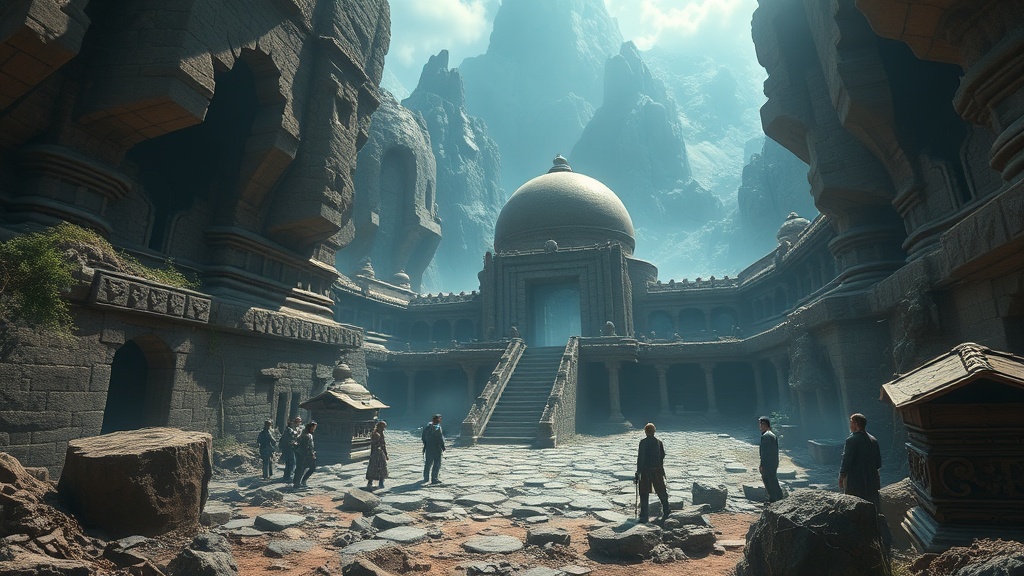
Digital Archeology: Unearthing the Forgotten Lore of Early MMO Worlds

The prevailing myth surrounding early Massively Multiplayer Online (MMO) games is that their "lore" was merely a thin veneer of text used to justify repetitive quest loops. Casual observers often dismiss the narratives of titles like Ultima Online or EverQuest as shallow, assuming that because the technical limitations of the late 90s prevented cinematic cutscenes, the depth of the world-building was equally restricted. This is a fundamental misunderstanding of how narrative density functions in a low-fidelity environment. In the absence of high-resolution textures and motion-captured facial animations, developers utilized systemic storytelling—a method where the world's rules, item descriptions, and even the physics of the engine itself served as the primary delivery mechanism for history.
Digital archaeology is not just about looking at old screenshots; it is the process of reverse-engineering the intent behind technical constraints. When we examine the architecture of early persistent worlds, we find that the "lore" was often baked into the very code and level design to compensate for a lack of visual fidelity. This required a level of precision in environmental design that modern, procedurally generated worlds often lack. To understand this, one must look at how developers utilized limited draw distances and collision boxes to create a sense of scale and mystery.
The Architecture of Absence: Using Technical Limits to Build Mythos
In the era of Ultima Online (1997), the technical constraints of the engine meant that the world was composed of discrete, tile-based segments. While modern players might see this as a limitation, for the original players, it created a sense of "the unknown." Because the engine could only render a certain number of entities and tiles before the client-side performance plummeted, the "fog of war" was a literal technical necessity that became a narrative tool. The gaps in the map were not just empty space; they were the frontiers of the known world.
This technique of using technical limitations to drive immersion is a form of deep environmental storytelling. Consider the way EverQuest (1999) handled its high-level zones. The technical difficulty of rendering large-scale terrain meant that many areas were walled off by impassable geometry or extreme level-scaling requirements. This created a psychological barrier that functioned as a "lore wall." Players didn't just see a mountain; they saw a structural impossibility that suggested a world far larger and more dangerous than their current capabilities. The narrative was told through the friction between the player's current build and the sheer verticality of the terrain.
The Semiotics of Item Descriptions and Tooltips
Because early MMOs could not rely on high-fidelity character models to convey status or history, they relied heavily on the semiotics of item data. In Asheron's Call, for instance, the lore was frequently tucked into the metadata of items. A common weapon might have a generic description, but a rare drop would feature a string of text that hinted at a specific historical event or a fallen deity. This forced players to engage with the inventory management screen not just as a utility, but as a reading exercise.
- Contextual Flavor Text: Using item descriptions to provide world-building without requiring a dedicated NPC interaction.
- The "Unlabeled" Item: Creating mystery through the absence of information, forcing players to speculate on the origins of rare loot.
- Stat-Driven Lore: When an item's unique mechanical properties (such as a specific resistance or a peculiar damage type) suggest a specific elemental or magical origin.
This level of detail required a rigorous documentation process. If a developer added a "Frost Brand" sword, the mechanical properties—resistance to fire, increased damage to fire-based mobs—had to align perfectly with the established world-building to maintain the illusion of a coherent reality. A mismatch between a weapon's stats and its descriptive text would immediately break the player's immersion, a failure often seen in modern titles that prioritize "loot drops" over narrative consistency.
Deconstructing the "Dead World" Phenomenon
A common challenge in digital archaeology is the "Dead World" problem: the realization that much of a game's lore is tied to a specific player base that no longer exists. When a server is decommissioned or a game transitions to a different engine, the "living" aspect of the lore—the social structures, the player-driven economies, and the guild histories—is lost. What remains is a skeleton of the original vision. This is where the technical truth becomes most apparent. When you look at the archived data of a defunct MMO, you see the raw bones of the world: the way the NPC spawn rates were tuned to create a sense of a bustling city, or how the economy was balanced to reflect the scarcity of certain resources.
To truly unearth this forgotten lore, one must look at the following technical artifacts:
- NPC Scripting Patterns: Analyzing the repetitive dialogue loops to understand the social hierarchy of a town. If the guards have a higher priority in the pathfinding algorithm, it reinforces their status as the primary authority in that zone.
- Zone Transition Latency: The way a game handles the loading of a new area can tell you about the intended "flow" of the world. Long load times or abrupt transitions often indicate a world that was built in disconnected "bubbles" rather than a seamless, interconnected ecosystem.
- Resource Node Density: The placement of herb, ore, and crafting nodes reveals the intended economic backbone of a region. A high density of iron nodes in a mountainous region is a technical way of telling a story about the geography and industry of that land.
The Role of Glitches in Narrative Perception
Interestingly, the "brokenness" of early code often contributed to the sense of an ancient, decaying world. A clipping error where a player could see through a wall into a hidden room wasn't just a bug; it was a "glitch-driven discovery." In many ways, these unintentional exposures of the underlying engine provided a glimpse into the "sub-strata" of the world, creating a sense of a world that was layered and complex. While modern QA processes aim to eliminate these, the early MMO era embraced the accidental mystery of the unrendered or the improperly collision-mapped.
For those interested in how these technical imperfections shape the player experience, studying cult classics that embrace broken code provides a necessary perspective. It highlights how a failure in the technical execution can inadvertently create a new layer of world-building that the developers never intended, but that the players eventually adopt as part of the game's "truth."
The Future of Digital Preservation
As we move further away from the era of dial-up connections and low-poly models, the task of digital archaeology becomes more urgent. We are losing the ability to experience these worlds in their native environments. Emulators and private servers are the only way to preserve the "feel" of the original technical constraints. Without the specific latency, the specific draw distances, and the specific limitations of the hardware, the lore loses its context. A story about a vast, empty wasteland feels different when you are playing on a high-speed fiber connection with 4K textures than it does when you are struggling through a 56k connection with a 640x480 resolution.
To preserve the lore of early MMOs, we must preserve the technical reality of their existence. This means more than just saving the text files; it means maintaining the ability to run the original builds on hardware that can replicate the intended performance profiles. Only then can we truly understand how the interplay between code and creativity built the foundations of the modern digital world.