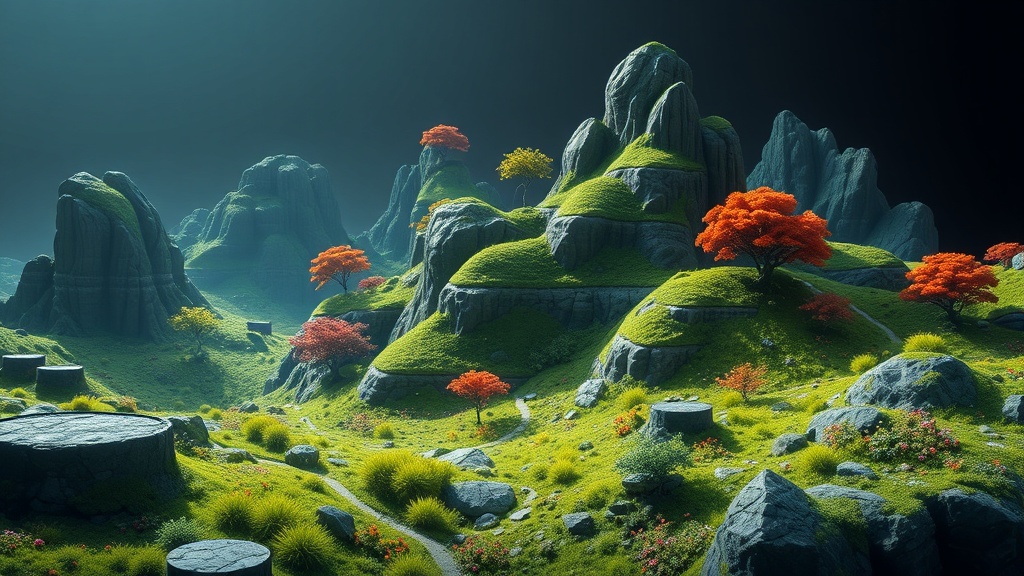
Why Procedural Generation is the Secret Sauce of Modern Gaming

I spent fifteen years in the trenches of Quality Assurance. I’ve spent more hours staring at broken collision meshes and unoptimized texture streaming than I care to admit. Back then, "procedural generation" was often a dirty word in the industry. It was the excuse developers used when they couldn't be bothered to hand-craft a level, or a way to mask a lack of actual content. If a game felt empty or repetitive, the finger was pointed at the algorithm.
But the landscape has shifted. We are no longer in the era of primitive random number generators that just spit out a slightly different arrangement of rocks. Modern procedural generation (ProcGen) has evolved into a sophisticated layer of mathematical architecture. It is no longer a crutch; it is the engine behind the most expansive, technically impressive experiences in gaming today. From the cosmic scale of No Man’s Sky to the claustrophobic, infinite loops of Returnal, ProcGen is the secret sauce that solves the greatest problem in modern development: the scalability of content versus the limitations of hardware and human labor.
The Core Conflict: Hand-Crafted vs. Algorithmic Content
To understand why ProcGen is essential, you have to understand the bottleneck of modern AAA development. In the "golden age" of gaming, a level designer could hand-place every light source, every crate, and every enemy spawn point. This resulted in highly curated, high-fidelity environments. However, as player expectations for scale have skyrocketed, hand-crafting has become a mathematical impossibility. You cannot hand-build a billion unique planets. You cannot manually code a trillion different dungeon layouts for a roguelike.
This creates a tension between fidelity and scale. If you go purely hand-crafted, your game is a beautiful, small box. If you go purely procedural without a strong framework, you get a "mile wide and an inch deep" experience—vast, empty landscapes that feel meaningless. The "secret sauce" is the hybridization of the two: using procedural systems to build the foundation, and hand-crafted assets to provide the soul.
The Three Pillars of Effective Procedural Generation
When I’m reviewing a game’s technical performance, I’m looking at how the engine handles these three specific areas. If these are poorly implemented, the game will feel "procedural" in the worst way—repetitive, predictable, and hollow.
- The Seed (The Foundation): Every procedural world begins with a seed—a string of numbers that dictates the starting point of the algorithm. A good system uses complex noise functions, such as Perlin Noise or Simplex Noise, to create natural-looking terrain. If the noise is too simple, you get the "rolling hills" effect where everything looks identical.
- The Ruleset (The Logic): This is the most critical part. A good algorithm doesn't just place objects randomly; it follows a set of biological or geological rules. For example, a tree shouldn't spawn in the middle of an ocean, and a dungeon shouldn't have a door that leads to a solid wall. This is where the "intelligence" of the generation happens.
- The Asset Library (The Texture): This is where the human element returns. The algorithm might decide "place a building here," but the quality of that building depends on the hand-crafted assets the developers provided. The algorithm is the architect; the artists are the suppliers.
Why It’s a Technical Necessity for Modern Hardware
As someone who spends a significant amount of time repairing GPUs and troubleshooting thermal throttling, I look at ProcGen through the lens of optimization. One of the biggest hurdles in modern gaming is VRAM management and Disk I/O.
In a traditional open-world game, the engine has to stream massive amounts of high-resolution texture data and geometry from the SSD to the GPU as the player moves. This is why we see "pop-in" or stuttering in many modern titles. Procedural generation offers a clever workaround. Instead of storing a massive, static world on your hard drive, the game stores a mathematical formula.
When you move into a new area, the game calculates what should be there in real-time. This reduces the footprint of the initial installation and allows for much more dynamic environments. By generating much of the detail on the fly, the engine can prioritize memory for the things that actually matter: high-fidelity character models, complex physics, and high-frequency frame rates. It is a way of trading CPU cycles for storage space, and in an era where SSD speeds are the bottleneck, it’s a brilliant trade-off.
The Roguelike Revolution: Replayability via Mathematics
We can't talk about ProcGen without acknowledging the massive resurgence of the roguelike and roguelite genres. Games like Hades, Dead Cells, and The Binding of Isaac use procedural generation not just for scale, but for replayability.
In a standard linear game, once you know the layout of a level, the tension evaporates. You’ve "solved" the game. In a procedural system, the player is forced to master systems rather than layouts. You aren't memorizing where the boss is; you are learning how to react to a specific set of variables that might present themselves in a dozen different ways. This shifts the skill ceiling. The player isn't just a student of geometry; they are a student of probability and adaptability.
"The goal of procedural generation in high-end gaming isn't to replace the designer, but to expand the designer's reach. It is the difference between drawing a single picture and creating a set of rules that can paint a thousand pictures."
The Pitfalls: When the Sauce Goes Sour
I’ve seen plenty of games fall into the "Procedural Trap." As a critic, I have zero patience for games that use ProcGen as a mask for a lack of depth. There are three major red flags I look for during my technical deep-dives:
- The "Samey-ness" Problem: If I can recognize the pattern of a mountain range or a dungeon layout after only twenty minutes of play, the algorithm is too shallow. This is often caused by a lack of varied "modules." If you only have five types of rocks, it doesn't matter how many ways you arrange them; the player's brain will recognize the repetition instantly.
- Collision and Pathfinding Failures: This is a QA nightmare. When a game generates its world on the fly, it is incredibly easy for the system to create a "broken" state—a ledge that is too high to climb, a door that is blocked by a procedurally placed tree, or a gap in the floor. If a game has high-quality graphics but broken collision, it is a failure of the procedural logic.
- Lack of Intentionality: A hand-crafted level tells a story. A designer places a skeleton next to a broken sword to tell you a battle happened there. A procedural system often struggles with this "environmental storytelling." If the world feels like it was generated by a machine rather than inhabited by people, the immersion breaks.
The Future: AI and Neural Proceduralism
Looking ahead, we are moving toward a new frontier: Neural Procedural Generation. We are already seeing the early stages of AI-assisted level design, where machine learning models are trained on human-made levels to learn the "feel" of good design.
The next generation of games won't just use Perlin noise to make hills; they will use sophisticated AI to generate coherent, logical, and even emotionally resonant environments. We will see NPCs with procedurally generated backstories that actually impact the world, and cities that grow and evolve based on player-driven economic simulations. This isn't just about making bigger maps; it's about making more reactive ones.
Final Technical Verdict
To the players: don't dismiss a game just because it uses procedural generation. Instead, look at how it uses it. Is the game using the algorithm to create a sense of wonder, or is it using it to hide a lack of effort?
If the game feels expansive, reactive, and technically sound, then you are witnessing the pinnacle of modern software engineering. Procedural generation is not the death of design; it is the evolution of it. It is the tool that allows us to move from being spectators of a static world to participants in a living, breathing, mathematical universe. Just keep an eye on those frame rates—no matter how infinite the world is, your hardware still has its limits.