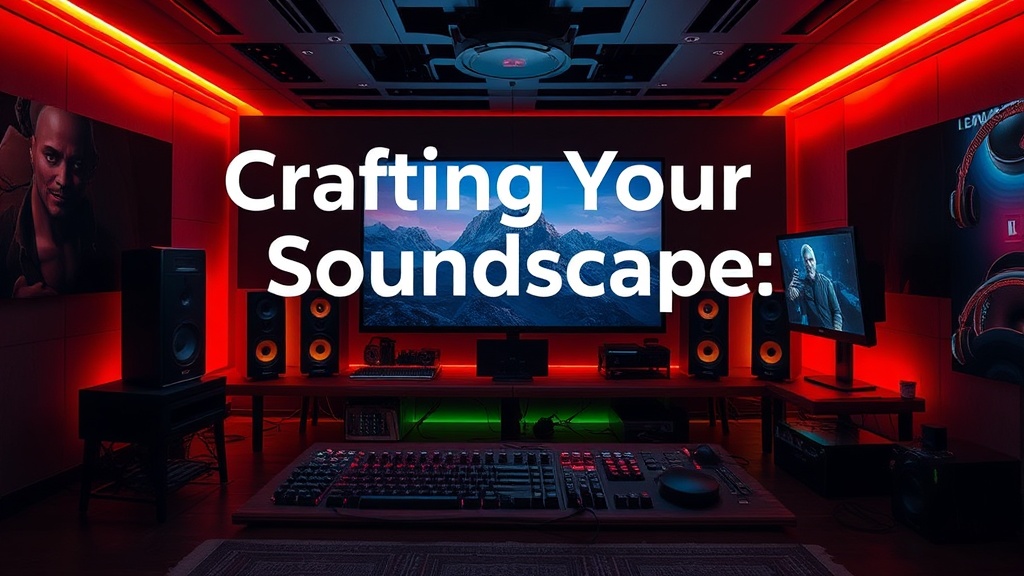
Crafting Your Perfect Soundscape: Setting Up Spatial Audio for Immersive Gaming

Approximately 70% of competitive players rely on auditory cues to identify enemy positioning, yet a significant majority are playing with suboptimal spatial configurations that actually distort directional accuracy. Most users assume that plugging in a high-end headset is the final step in an audio setup, but without proper software calibration and hardware synchronization, you are likely experiencing "phantom imaging"—where a sound appears to come from a direction it isn't actually originating from.
Spatial audio is not just "surround sound." While traditional 7.1 surround sound relies on pre-rendered channels to simulate a multi-speaker environment, true spatial audio utilizes Head-Related Transfer Functions (HRTF) to trick your brain into perceiving height, depth, and precise 360-degree azimuth. If you are playing a tactical shooter like Counter-Strike 2 or Valorant, understanding the difference between channel-based audio and object-based spatial audio is the difference between a headshot and a death screen.
The Hardware Foundation: DACs, Amps, and Impedance
Before touching a single software setting, you must audit your hardware chain. A common mistake is relying on the onboard audio chip of a standard motherboard. Most consumer-grade motherboards, even those marketed as "gaming" boards, suffer from high electromagnetic interference (EMI) and poor signal-to-noise ratios. This creates a "noise floor" that masks the subtle high-frequency transients required for spatial positioning.
If you are using high-impedance headphones, such as the Beyerdynamic DT 1990 Pro or the Sennheiser HD 660S2, a standard USB port or a cheap 3.5mm jack will not suffice. You require a dedicated Digital-to-Analog Converter (DAC) and an amplifier. A DAC converts the binary 0s and 1s from your game into an analog signal, while the amp provides the voltage necessary to drive the drivers of your headphones. Without sufficient power, the low-end frequencies will feel "muddy," which effectively collapses your soundstage and destroys your ability to perceive distance.
For those on a budget, look for an external USB DAC/Amp combo like the Schit Magni/Modi stack or the Creative Sound BlasterX G6. These devices provide a cleaner signal path and allow you to bypass the electrical noise generated by your GPU and CPU, ensuring that the subtle footsteps in Apex Legends aren't lost in a sea of electronic hiss.
Software Calibration: Windows Sonic vs. Dolby Atmos vs. DTS
Once your hardware is capable of delivering a clean signal, you must decide how your OS will process spatial data. Windows offers three primary paths, each with distinct technical trade-offs:
- Windows Sonic: This is the free, native implementation. While it is a decent baseline, it often suffers from "narrow imaging," meaning the soundstage feels too close to your head. It lacks the sophisticated HRTF algorithms found in paid versions.
- Dolby Atmos for Headphones: This is widely considered the gold standard for cinematic immersion. It excels at verticality—making it easier to tell if an enemy is above or below you in Call of Duty: Warzone. However, some competitive players find the "smoothing" effect of Dolby slightly detrimental to raw directional precision.
- DTS Headphone:X: DTS tends to offer a wider, more expansive soundstage. If you are playing open-world RPGs or immersive sims where environmental scale is key, DTS often provides a more "epic" feel, though it can occasionally feel less precise in tight, competitive corners.
Pro Tip: Do not enable multiple spatial audio layers. If you turn on Dolby Atmos in Windows, ensure that any "7.1 Virtual Surround" settings within your headset's proprietary software (like Logitech G Hub or Razer Synapse) are turned off. Running two spatial processing engines simultaneously results in "double-processing," which creates phase cancellation and makes audio cues sound hollow and physically impossible.
Optimizing the In-Game Engine
The most sophisticated Windows settings are useless if the game engine itself is fighting them. Modern titles like Battlefield 2042 or Rainbow Six Siege have built-in spatial audio engines designed to work with specific hardware configurations. You must align your game settings with your OS settings.
- The "Stereo" Rule: If you are using a high-end spatial audio solution like Dolby Atmos or a dedicated external sound card, many professional players actually set their in-game audio to "Stereo" or "Headphones" rather than "7.1 Surround." This is because the game's stereo output is often a highly optimized, uncompressed signal that the Windows spatializer can then wrap in its own HRTF algorithm more effectively.
- Dynamic Range Settings: Always look for a "Night Mode" or "Low Dynamic Range" setting if you are struggling to hear footsteps. While "High Dynamic Range" (HDR) makes explosions sound massive and terrifying, it also pushes the volume of quiet sounds (like footsteps) much lower relative to the peak volume of an explosion. In a competitive environment, a lower dynamic range ensures that the volume gap between a grenade and a footstep is minimized.
- Audio Latency: Ensure your audio buffer is optimized. If you are using an ASIO driver for your DAC, ensure your buffer size is set to 128 or 256 samples. Anything higher will introduce perceptible latency between a visual cue (a muzzle flash) and the sound, breaking your immersion and your reaction time.
The Physics of Sound: Room Acoustics and Physical Setup
While most of our focus is on what happens inside the headphones, the physical environment of your "battlestation" still plays a role, especially if you use desktop speakers for non-gaming tasks. If you are using a high-end setup, you should consider designing the perfect ergonomic battlestation that accounts for acoustic treatment.
Hard surfaces like wooden desks, glass windows, and bare walls cause sound waves to bounce, creating "standing waves" and echoes. If you use speakers, these reflections can muddy the soundstage. Even when wearing headphones, the "occlusion effect"—how much sound leaks from your headphones into your ears—is affected by your environment. If you are in a highly resonant, echoey room, the lack of external isolation can make it harder to focus on the micro-details of a game's audio engine.
For the ultimate setup, consider a small area rug or acoustic foam panels behind your monitor. This reduces the "reverberation" in your immediate workspace, which, while subtle, helps maintain the mental focus required for high-stakes gaming. A controlled environment leads to a controlled auditory experience.
Troubleshooting Common Audio Issues
If you have configured everything and things still sound "off," check these three common technical culprits:
1. The "Muffled" Sound: This is often caused by an incorrect sample rate. Right-click the speaker icon in your taskbar, go to Sound Settings, and check your Properties. If your device is set to 44.1kHz but your game is outputting at 48kHz, you may experience subtle artifacts or a perceived loss of clarity. For modern gaming, 24-bit, 48000Hz is the industry standard for a reason. Set everything to match.
2. The "One-Sided" Soundstage: If sounds feel like they are leaning heavily to one ear, check your Windows Balance settings. Even a 1% or 2% deviation can ruin your ability to track movement in Apex Legends. Furthermore, ensure your headphones are seated correctly; even a slight tilt in how the ear cup sits on your pinna (the outer ear) can change the HRTF profile and ruin your spatial perception.
3. High Latency/Lag: If the audio feels "behind" the video, you are likely using a Bluetooth device. Never use Bluetooth for competitive gaming. The latency inherent in the Bluetooth stack (even with low-latency codecs like aptX Low Latency) is too high for real-time spatial tracking. Always use a wired connection (USB or 3.5mm) to ensure a direct, zero-latency path from the DAC to your ears.
"Audio is 50% of the game, but most players treat it as an afterthought. If you want to truly master your environment, stop listening to the marketing and start tuning the signal."
Setting up a perfect soundscape is a technical process of elimination. Start with the cleanest hardware, move to a single, high-quality software spatializer, and ensure your in-game settings are not fighting your OS. Once these variables are controlled, the game world will stop being a collection of sounds and start being a three-dimensional space you can actually navigate.
Steps
- 1
Check Hardware Compatibility
- 2
Enable Windows Sonic or Dolby Atmos
- 3
Calibrate Your Headset Software
- 4
In-Game Audio Setting Optimization